Revenue for OpenAI and Anthropic has grown wildly. OpenAI grew from $6B to $20B in annualized run-rate revenue over the course of 2025 and reached $24B in March; Anthropic grew its ARR from $1B to $14B over the same time frame and was at $47B in May. These are “never before seen in the history of capitalism” growth rates which make near trillion-dollar pre-IPO valuations seem rational (perhaps even underpriced).
But can that growth continue? I’m not talking about the supply constraints right now on compute (SemiAnalysis covers this extensively), I’m thinking about the demand side of the equation. Will companies continue to pay for models for Anthropic and OpenAI when models from China are seemingly so close behind in intelligence and so much cheaper?
The Demand Curve
Here’s the framework I’ve thought of. First, imagine a bunch of tasks, and arrange them from easiest to hardest.
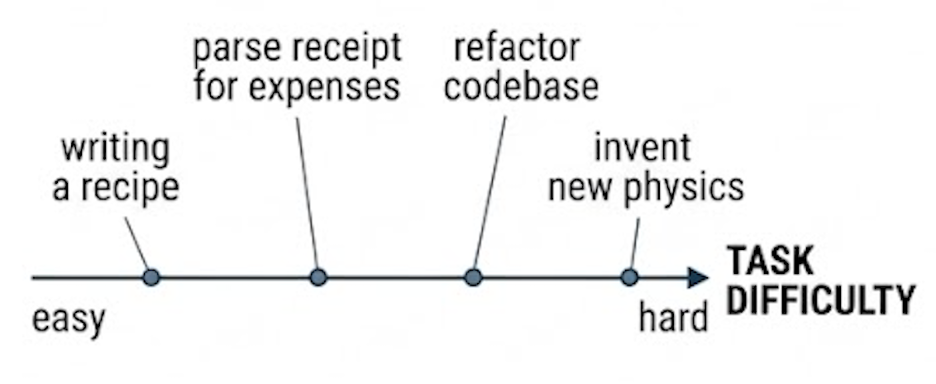
Now imagine you could quantify the revenue opportunity for AI in fulfilling all of the instances of that task. That’s probably a product of quantity (how often that task is done) and value (you’re willing to pay significantly more for a high-alpha financial insight or cancer drug than you are for a pot roast recipe). We can add that as our second dimension, and imagine all of the tasks in the economy as blocks of various heights that stack on top of each other to form a nice curve:
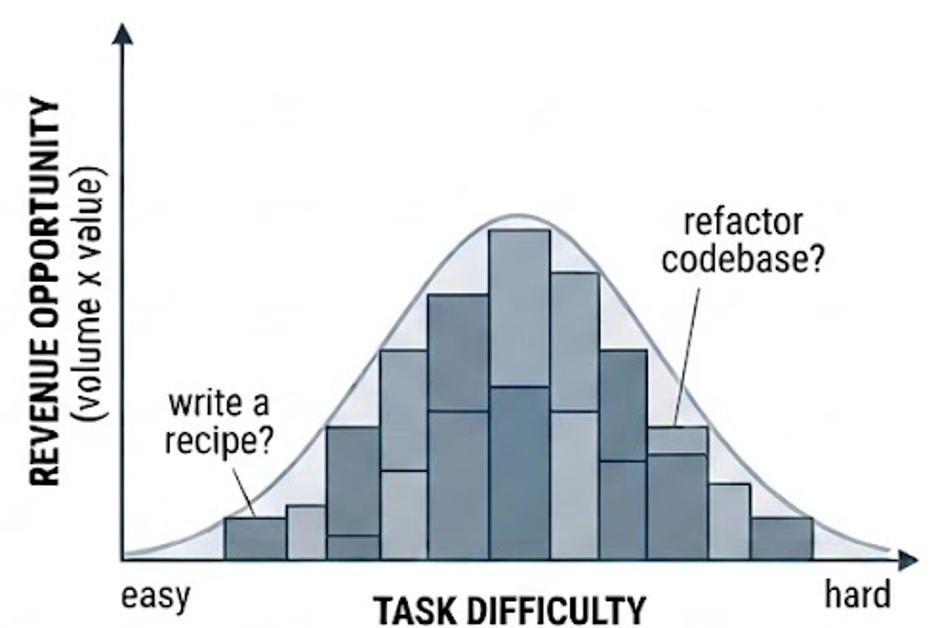
We could argue about which specific tasks are where, and how big they are, but this is primarily illustrative. Perhaps token consumption on the y-axis would be a better fit, but again… illustrative!
Now let’s imagine a line that sweeps through the chart, moving from left to right over time that represents what AI is capable of today. This is the frontier line; everything to the left of it is automatable with some AI model + harness combination [1]. Behind that is another line representing the cheap model frontier. Now our tasks are divided into three categories:
Those which can be done by very inexpensive models (open or otherwise) and frontier models alike.
Those which can be done only by frontier models, inexpensive models aren’t yet capable of doing these tasks.
Those which can’t be done by AI today, for any price.
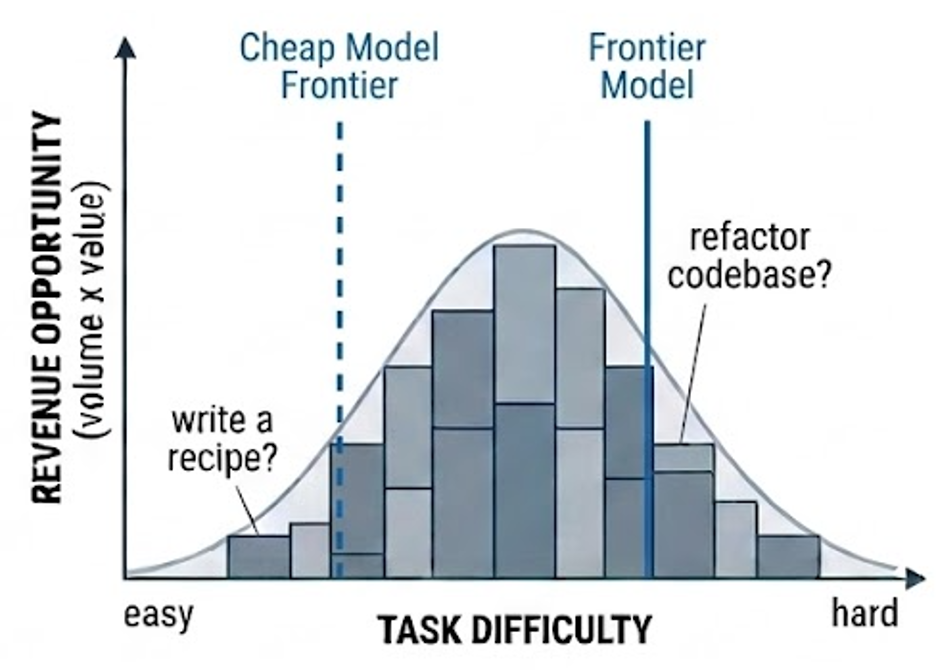
I think the frontier model capabilities line is too far to the right in this example, but we’ll touch on that in a bit.
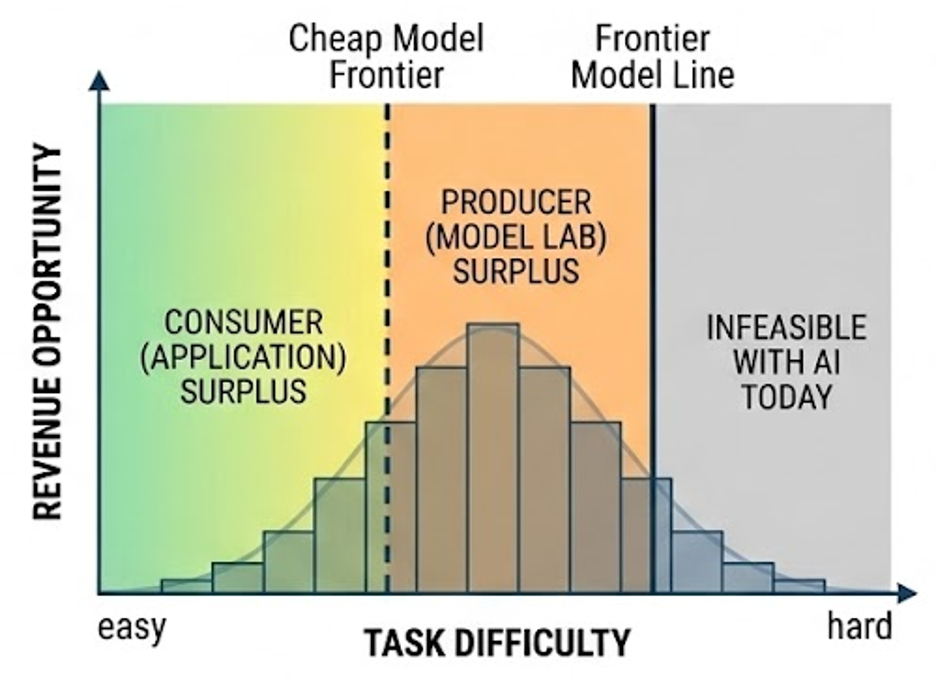
What defines “cheap”? Broadly, I’m using it as a proxy for the open-weight frontier, though cheap closed-weight models (e.g., GPT-5.6-Luna post-price-reduction) may also compete here. Open-weight models have competition at the inferencing layer, and so you’ll have dozens of companies competing to serve a model at lower prices with higher reliability at faster speeds (and you’ll have companies whose whole job is to simplify that choice) [2]. Open-weight models (without restrictive licenses) are inherently commoditized; a cheap closed-source model that achieves similar price-performance ratios is fundamentally in the same boat.
Given the dynamics around inference-layer competition and cost concerns from enterprises, tasks that can be done sufficiently well by commoditized models generate consumer (application) surplus rather than producer (inference provider or model lab) surplus. Tasks that are only able to be done by a handful of frontier AI models, however, should generate producer surplus rather than consumer surplus; it’s this strip in the middle that truly drives frontier labs’ revenue [3]. (I’ve included an appendix section at the bottom that shows the difference between token share and spend share on OpenRouter.)
As a side note, I really like how Jesse Zhang explains the dynamics behind the transition from closed frontier models to open-weight ones:
“...When a use case is new, you want the smartest general-purpose model you can get. You don't know the shape of the problem yet, so you pay a premium for intelligence you may not end up needing. That's the right trade at that stage. But once the use case is fully built out, when you know the distribution of inputs, the behaviors you need, and the failure modes to guard against, the trade flips. Now general intelligence is overhead, and you want the smallest, fastest model fine-tuned to do your specific thing extremely well.”
Jesse’s point is reflective of Decagon’s needs: Decagon cares a lot about latency and has the technical expertise to fine-tune models. Strip away Decagon’s idiosyncracies, and I wager that most companies don’t care about closed vs. open weights but instead just want the cheapest model to do [insert your favorite task] at a sufficient performance level.
Back to the main point: I’ve been drawing this chart to look like a bell curve. But how do we know what shape this curve looks like? I think the left half is accurate: the frontier model labs have experienced exponential growth in their revenue, and inference providers are also growing exponentially. This best fits an exponential ramp-up in demand for AI. But what does the right half look like? We know that there are tasks out there that AI can’t do reliably yet, but do we know if there are more or less of those tasks compared to what we’ve been able to achieve so far?
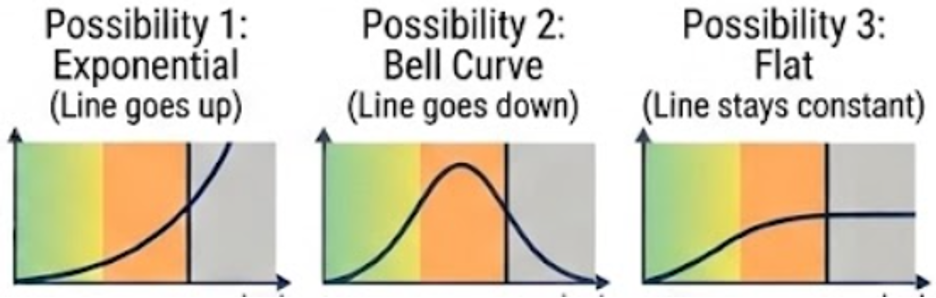
Possibility 1: Line goes up.
This is in some ways the status quo to what we’ve seen thus far. In this scenario, token demand continues to grow exponentially, and even as the cheap models lag behind, they rack up ever more usage. Frontier model labs enjoy continued exponential growth in their revenue, training ever more powerful models. For this to happen, new tasks that we can’t even predict today would need to emerge faster than the cheap model frontier swallows up older tasks. Perhaps a useful analogy here would be to the microprocessor and the Internet, which completely reshaped the economy and created new job categories that we couldn’t have possibly predicted decades ago.
Possibility 2: Line goes down.
Suppose instead that fewer new tasks emerge. Alternatively, imagine a world in which Fable 10 is better than Fable 9, but there’s nothing of economic value in new tasks that demand that level of intelligence vs. some cheap model that’s the equivalent of Fable 8. This would necessitate a ramp down in the curve, and would quite possibly spell the death of the frontier model labs: commoditized models would capture the bulk of AI spend in the economy, and though the model labs and inference providers don’t earn generational returns, the entire economy would enjoy a massive tailwind from cheap and intelligent AI.
Possibility 3: Line stays flat.
In between those two scenarios is a world where model lab revenues hold more or less constant. Probably, this means new use cases emerging at the same rate at which the cheap model frontier eats existing ones, but the net effect would be that cheap model providers rack up additional token usage (even as profits remain ordinary).
I don’t think it’s possible to know today which of these three scenarios will occur. But your answer to that question determines how you view the future of model labs’ revenues.
New Pricing Models
There’s another lever which matters to the story of the frontier labs, and it has to do with value capture. Frontier labs today have 2 business models: (1) sell subscriptions to consumers, and (2) sell tokens via an API on a per-token basis. (2) is the more relevant driver of revenue, but the labs don’t price discriminate on use cases: if you’re using Fable or Sol to develop a new blockbuster drug you pay the same per token as someone that’s using AI to track seat availability for showings of The Odyssey.
Here, I’m reminded of a Sierra blog post which cites Madhavan Ramanujam’s thoughts on charging for software. TL;DR, you can charge for outcomes when (1) the software is highly autonomous and agentic, and (2) when you can cleanly attribute success to AI (e.g., an AI system discovered a new molecule, solved a customer support ticket, etc. without a human in the loop). Perhaps a focused push for agentic products for specific verticals (e.g., cybersecurity, healthcare, finance, legal) could result in outcome-based pricing that (greatly) increases the % of value captured by the models themselves.
Ultimately, however, I doubt that this will fundamentally change the dynamics I laid out above: once a task can be done by a commoditized model well enough, pricing power will go away; capturing a greater share of value between the commoditized and frontier model lines won’t determine if the curve of tasks bends up or down or not at all.
Appendix: Token share vs. $ share
To further drive home the points of “open-weight models are commoditized” and “open-weight models create consumer surplus”, take a look at this OpenRouter data comparing token share against spend share for different model labs (data as of 2026-07-27) [4]. Anthropic and OpenAI both have ~10-13x the spend share relative to their token share. Google may be lower due to the lack of a recent Gemini Pro model release.
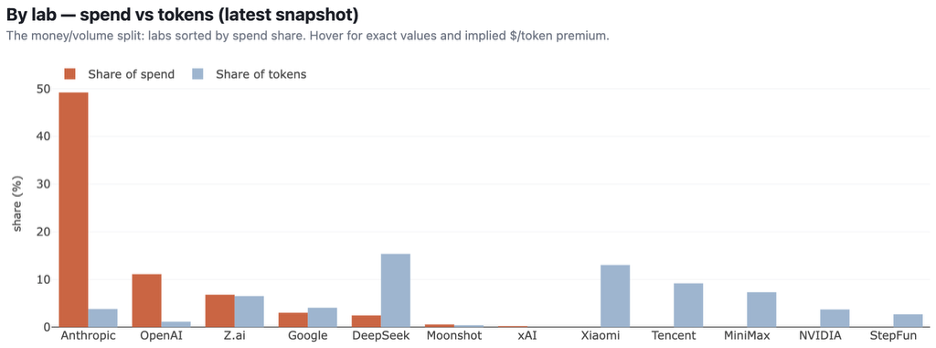
The relevant Claude Skill for generating this data is available here.
[1] AI actually automating these tasks will take some time, diffusion isn’t instant.
[2] Here, the economics of perfect competition or monopolistic competition are probably more likely to apply.
[3] At least, it’s more reasonable to think that the standard economic models of oligopoly would apply. In practice, despite a lot of bellyaching by companies, I personally don’t think that frontier model labs are really charging all that much for what anyone a few years ago would call AGI.
[4] It’s an incomplete data source: OpenRouter publishes share of spend and share of tokens for the top 10 models across a variety of use cases, so we don’t see beyond the top 10. Ultimately, we’re able to pin down ~75% of the spend and ~66% of token usage.
Thanks to Charlie Ferguson and Claude Fable 5 for helping me think through this topic. Charts made with Gemini.
Disclaimer: I own equity in some large tech companies which have equity stakes in OpenAI and Anthropic. My family has a stake in OpenAI.